What are the Minor Arcana?
Of the 78 cards in a tarot deck, 56 are Minor Arcana. They form four suits of 14 cards: an ace, the numbers two through ten, and four court cards. If the Major Arcana are the big life themes and turning points, the Minor Arcana are what an ordinary day is made of: a conversation with a coworker, a decision about a purchase, second thoughts before answering, a warm evening. That is why, in practice, spreads about “what should I do in this situation” contain more Minor Arcana.
Their logic is simpler than it looks: the suit tells you which area of life is involved, the number tells you what stage the situation is at, and the picture shows how it plays out. Once you have those three layers, you can read even cards whose meanings you don’t remember. The deck’s overall structure is described in “What Is Tarot? A Beginner’s Guide”.
The four suits: Wands, Cups, Swords, Pentacles
In the Rider–Waite tradition, and in the Golden Dawn order connected with it, each suit is linked with an element. This is a traditional convention, not a universal law: other decks may name the suits differently (Coins, Disks, Staves) or match the elements another way. As a memory aid, though, it is very handy.
- Wandsfireaction, energy, ambition, creativityThe suit’s question: “What do I want, and what am I doing about it?”
- Cupswaterfeelings, relationships, intuition, imaginationThe suit’s question: “What do I feel, and what is missing?”
- Swordsairthoughts, words, decisions, conflictThe suit’s question: “What do I think, and what do I need to understand?”
- Pentaclesearthwork, money, the body, daily life, resultsThe suit’s question: “What am I building, and what can I rely on?”
It helps to read the suits as an answer to “where is this happening?”: feelings (Cups), thoughts (Swords), work and money (Pentacles), energy and goals (Wands). If one suit dominates a spread, the situation is “circling” in one area: lots of Cups means the question is about relationships and emotions, lots of Swords about conversations, decisions, and conflict, lots of Pentacles about work, money, and daily life, and lots of Wands about goals and action.
Numbers as a story: from ace to ten
The numbered cards form a path of ten steps. It repeats in every suit; only the area of life changes. First the general logic, then how each number sounds in the four suits.
- Ace Beginning, seed, potential
- Wandsa spark of an idea, impulse
- Cupsa new feeling, openness
- Swordsa clear thought, a decision
- Pentaclesa new opportunity, a resource
- Two Choice, partnership, balance
- Wandschoosing a direction, planning
- Cupsmutuality, union
- Swordsstalemate, refusing to look
- Pentaclesjuggling tasks
- Three Growth, first fruits, others getting involved
- Wandsexpansion, awaiting results
- Cupsjoy, friendship, celebration
- Swordsheartache, separation
- Pentaclesteamwork, recognition of skill
- Four Stability and stagnation
- Wandsa milestone, a stable harbor
- Cupsapathy, overlooking what is offered
- Swordsrest, recovery
- Pentaclesholding on, seeking security
- Five Crisis, conflict, loss
- Wandsrivalry
- Cupsregret, mourning
- Swordsa win at the cost of relationships
- Pentacleshardship, feeling isolated
- Six Harmony after crisis
- Wandsvictory, recognition
- Cupsmemories, warm connections
- Swordsmoving on to calmer waters
- Pentaclesgenerosity, exchange
- Seven A test, choosing a strategy
- Wandsdefending your position
- Cupsillusions, too many options
- Swordscunning, acting alone
- Pentaclesassessment, patience
- Eight Movement, work, limitation
- Wandsspeed, fast-moving events
- Cupswalking away from the familiar
- Swordsrestriction, a “trap” of thoughts
- Pentacleshoning a craft
- Nine Nearly there, results at the doorstep
- Wandsweariness and resilience
- Cupsa wish fulfilled, contentment
- Swordsanxiety, sleepless thoughts
- Pentaclesindependence, fruits of your work
- Ten The end of a cycle, a limit
- Wandsoverload, burden
- Cupsfamily harmony, fullness
- Swordsthe end of a hard chapter, “rock bottom”
- Pentaclesabundance, legacy, stability
You can remember the overall plot like this: ace is the seed; two is a choice; three is growth; four is stability; five is crisis; six is recovery; seven is a test; eight is movement; nine is nearly there; ten is the completion of a cycle. That gives you a practical trick: if you forget a card’s meaning, name the stage of the number and add the area of the suit. The Five of Swords is “crisis in the realm of thought and words,” which means conflict; the Four of Pentacles is “holding on in the realm of money and security.”
Court cards: Page, Knight, Queen, King
Court cards are the blurriest in the deck, and they are where beginners stumble most often. The reason is that they can mean several different things:
- A real person: the one you are asking about, or someone who will play a part in the situation.
- A role or state: how you are showing up right now, such as the diligent Page, the impulsive Knight, or the mature Queen.
- A style or approach: you are encouraged to act “like the King of Swords,” meaning impartially and logically.
- An event: this applies especially to Pages, who are often read as news or an invitation.
Honestly, there is no universal rule, and different schools read them differently. A practical compromise: if your question is about a specific person and the card matches them by description, read it as that person; if your question is about you, read it as your role; if neither fits, read it as an approach you can apply. The age, gender, and appearance on the card are conventions: a Queen can describe a man, and a Knight can describe a woman.
What each rank means
- Page Curiosity, news, learning, a first step.Wands: an idea and excitement; Cups: a tender feeling or a message; Swords: questions and observation; Pentacles: study and first practical steps.
- Knight Moving toward a goal, the suit expressed in its extreme.Wands: impulse and adventure; Cups: the romantic, a proposal; Swords: swiftness, sharpness; Pentacles: persistence and method.
- Queen Mature command of the suit’s inner world, care, and presence.Wands: charisma and confidence; Cups: empathy and depth; Swords: clarity and honesty; Pentacles: practical care and resources.
- King Leadership and responsibility in the suit’s outer world.Wands: the leader and visionary; Cups: mature emotional control; Swords: intellectual authority, judgment; Pentacles: reliability and the ability to earn.
It helps to tell the pairs apart: the Queen is inner command of the element (how you feel, think, and care), the King is outer command (how you lead, decide, and take responsibility). And the Knight is the most dynamic rank: it is about movement and a tendency toward the extremes of the suit.
How the Minor and Major Arcana work together
A real spread almost always contains both types. A simple hierarchy applies: the Major Arcana card sets the theme, and the Minor Arcana show how it plays out in life. For example, The Moon (anxiety, uncertainty) next to the Seven of Cups (many options, illusions) suggests that what complicates the choice is not a lack of information but too many daydreams and fears. The same Moon next to the Nine of Pentacles is about being in a stable position while intuitively sensing uncertainty.
A Major Arcana card among Minor cards reads “louder.” If a spread has just one, start with it: it is the main point. If there are no Major Arcana, look for the dominant suit and number. For example, two or three 5s or 10s at once signal that the situation has reached a crisis or the end of a cycle. For more on how the first group works, see the article on the Major Arcana.
Elemental dignities: the light version
The Golden Dawn tradition has an idea called “elemental dignities”: the elements of neighboring cards strengthen or weaken each other. Here is the simplest version:
- Fire and air (Wands and Swords) are considered friendly: air fans fire, and an idea feeds action.
- Water and earth (Cups and Pentacles) are also friendly: feelings get a practical foundation.
- Fire and water (Wands and Cups), as well as air and earth (Swords and Pentacles), are considered opposed: impulse is dampened by emotion, and thought gets bogged down in daily chores.
Use this as an extra hint, not a hard rule: if Wands and Cups sit side by side, that is not “bad,” it just means action and feeling pull in different directions, and it’s worth noticing which one you are prioritizing.
Examples: reading four cards
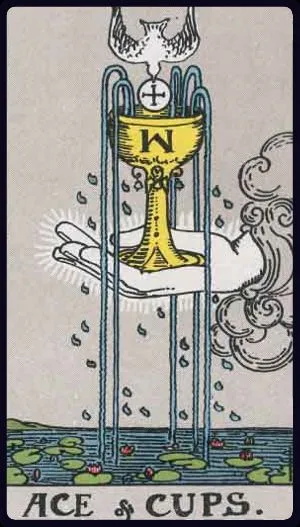
- Ace of Cups. Openness and a new feeling: in the “advice” position, allow yourself to be sincere rather than playing a part. In a business question, an emotional lift and real interest in the work.
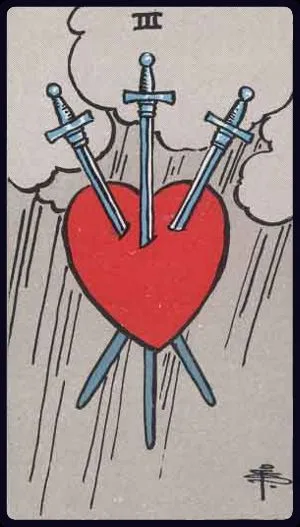
- Three of Swords. Pain that can’t be missed: a heart pierced by three blades against a rainy sky. Usually it is not a “prediction of grief” but an acknowledgment that something said or done hurts; the card advises not drowning out the feeling but naming it.
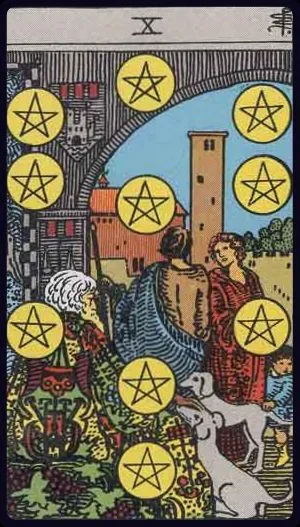
- Ten of Pentacles. Long-term stability: family, legacy, what has been accumulated. In a question about work, a reliable, steady foundation; in a question about relationships, a shared home and shared values.
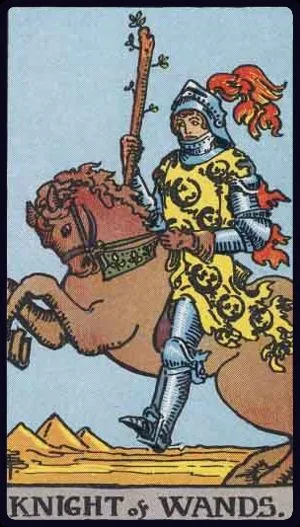
- Knight of Wands. Impulse and speed. As a person, someone passionate and charismatic but changeable; as advice, act quickly while making sure the drive doesn’t burn through your resources.
Common mistakes when reading the Minor Arcana
- Reading the Ten of Swords literally. Swords in the back look frightening, but this is a card of endings: what tormented you is over. There is a sunrise on the horizon, and that is the point.
- Assuming “Pentacles = only money.” It is also work, the health of your habits, daily life, home, and all “earthly” results.
- Assuming “Cups = only love.” It is every feeling: friendship, creativity, pleasure, and also illusions and escape from reality.
- Sorting cards into “good” and “bad.” The Five of Pentacles in the “advice” position is a signal to ask for help, not to wait for a blow.
- Reading cards in isolation. Suit and number matter only in combination with the position and the neighbors.
- Assuming a court card is always a person. Check whether it describes you or your approach.
All meanings and examples are collected in the tarot card meanings section, and you can read about reversed positions in the article on reversed cards. To put what you’ve learned to use right away, try a three-card spread or ask your question in a free spread; for how to word a question, read “How to Ask Tarot Questions.”
Oracul draws cards from the full deck and explains how suits and numbers come together as an answer to your question.
Frequently asked questions
How many Minor Arcana cards are in tarot?
56 cards: four suits of 14 cards each. Every suit has an ace, numbered cards from 2 to 10, and four court cards: Page, Knight, Queen, and King.
What is the difference between the Major and Minor Arcana?
The Major Arcana describe big themes and turning points; the Minor Arcana describe specific situations, emotions, and actions in everyday life. When a spread has many Minor Arcana, the question usually concerns current matters you can influence directly.
How do I remember the tarot suits?
Start with the elements in the Rider–Waite tradition: Wands are fire (action), Cups are water (feelings), Swords are air (thought), and Pentacles are earth (money and work). It is a convention, but it gives you a foothold quickly.
Are tarot court cards people?
Sometimes: they can describe real people, but more often they describe a mood, a role, or an approach that is useful to you. There is no single rule, so look at the question and the position: if you ask about a person, the court card is probably about them; if you ask about yourself, it is about your role.
Is the Ten of Swords a disaster?
No. The picture is dramatic, but the card usually marks the end of a painful chapter: it can’t hit harder than this. There is a sunrise on the horizon, and that is an important signal.
Can a reading be done with only Minor Arcana?
Yes. Many spreads for a specific question come up almost entirely in Minor Arcana, and that’s fine. There may be no Major Arcana at all when the question is about an everyday situation.