In this article
- 1What is tarot?
- 2How the deck is built: 78 cards
- 3Where tarot came from
- 4How a spread works
- 5How it works and why it helps
- 6Reversed cards
- 7Reading a story, not a list
- 8Your first reading, step by step
- 9A worked example
- 108 common misconceptions
- 11Online or a live reader
- 12Ethics and limits
- 13What to read next
- 14Frequently asked questions
What is tarot?
Tarot is a deck of 78 cards. Each card has a picture, a title, and (for some cards) a number. The cards are shuffled, a few are drawn, and they are laid out in a set order. That layout is called a spread. Each position in the spread asks its own question, such as “what is happening now,” “what is in the way,” or “what can help,” and the card that lands there gives you an image to look at that question through.
The word “tarot” actually covers three different things that often get mixed up. The first is a card game: since the 15th century, Italy has had a trick-taking game played with a special deck, and it is still played in several European countries. The second is a language of images: a set of symbolic pictures that has gathered many interpretations over the centuries. The third is the practice of readings and reflection, where those pictures become a prompt for thinking about your own life. When someone says “I did a tarot reading” today, they mean the third.
How the deck is built: 78 cards
The deck splits into two unequal parts: the Major Arcana (22 cards) and the Minor Arcana (56 cards). “Arcana” here simply means “cards.” In older texts the word is translated as “secrets,” which is where its mystical aura comes from.
- Major Arcana, 22 cards. Cards numbered 0 through XXI with names like The Fool, The High Priestess, Wheel of Fortune, The Tower, and The World. They describe big life themes and turning points. More in the article on the Major Arcana.
- Minor Arcana, 56 cards. Four suits of 14 cards each. The suits are Wands, Cups, Swords, and Pentacles (other decks call the last one Coins or Disks). Each suit has ten numbered cards, from ace to ten, and four court cards: Page, Knight, Queen, and King. The Minor Arcana speak to everyday life: work, relationships, thoughts, money. See the article on the Minor Arcana.
The math is simple: 22 + 4 × 14 = 78. When a spread is heavy on Major Arcana, it usually points to events you can’t skip or sidestep. When Minor Arcana dominate, it is about day-to-day matters you can influence directly.
What “Rider–Waite–Smith deck” means
There are many tarot decks with different artwork and even different numbering for some cards. The most recognizable is the Rider–Waite–Smith. Its concept was developed by Arthur Edward Waite, all 78 images were drawn by the artist Pamela Colman Smith, and it was published in 1909 by the London publisher William Rider & Son. The deck’s defining feature is that every card, Minor Arcana included, shows a scene. The Three of Swords is a heart pierced by three blades in the rain; the Eight of Pentacles is a craftsman patiently carving yet another symbol onto a coin. You can “read” a scene with your eyes even without knowing the textbook meaning, which is why most beginners start with this deck. It is also the deck Oracul uses.
The numbering is worth remembering: in the Rider–Waite deck, Strength is card VIII and Justice is XI. In older Marseille decks they are the other way around. If you see a different order in a book, that is not a mistake, just another tradition.
Where tarot came from: what we know for certain
Tarot is surrounded by beautiful legends about ancient Egypt, secret priests, and a lost book of wisdom. Unfortunately, historians don’t support them. What can be said with confidence fits in three paragraphs.
15th century: a card game. The oldest surviving decks of this kind appear in northern Italy in the 15th century. The game was called tarocchi, and besides the familiar four suits it had a separate group of illustrated trump cards. Hand-painted decks were commissioned by noble families; there are well-known decks connected with the Visconti and Sforza dukes of Milan. At the time it was strictly a game: cards took tricks with trumps, and nobody interpreted them.
From the second half of the 18th century: cards as a symbolic language. By then, authors in France had begun to treat the cards as a vehicle for secret knowledge and a tool for divination. The popular idea of tarot’s Egyptian origin came from exactly that period; there is no earlier evidence of such use. Later, in the 19th century, occult societies joined in and tied the cards to astrology, Kabbalah, and the system of elements.
1909: the Rider–Waite–Smith deck. Waite, who was connected with one of those societies (the Hermetic Order of the Golden Dawn), and the artist Pamela Colman Smith created a deck with illustrated scenes on all 78 cards. This is, in effect, the modern “standard”: most decks published since then either build on it or push back against it.
How a spread works: position, card, and neighbors
A single card is a word; a spread is a sentence. Meaning appears when you read three layers at once.
- Position. Its place in the layout sets the question. The same Tower means a shock you have already lived through in the “past” position, a fear of sudden change in the “obstacle” position, and advice not to cling to what is already collapsing in the “advice” position.
- Card. The picture and its key themes: what is happening in the image, what emotion it carries, what action it shows. Reference-book meanings are a starting point, not a verdict.
- Neighbors. Cards in adjacent positions color each other: the Three of Swords reads differently beside the Three of Cups than beside the Ten of Pentacles. The figures’ gaze matters too: when figures on neighboring cards look toward each other, the link often feels like a conversation; when they look away, it feels like a break or two parallel lines.
The popular spreads differ only in the number of positions. The card of the day is a single position: “what to pay attention to today.” The three-card spread is the most versatile layout; see the article “Three-Card Spread: How to Read Past, Present, Future” for details. The Celtic Cross uses ten positions for a complex question. And a free spread lets you ask in your own words without choosing a layout in advance.
How it works and why it helps
The honest answer is that the cards don’t know your future. There is no convincing evidence that a randomly drawn card reflects upcoming events, and we won’t pretend there is. Still, millions of people use tarot for years, and not out of mere curiosity. The reasons are quite ordinary.
- Projection. A picture is ambiguous, and as you look at it, you can’t help reading into it what really concerns you. The spread becomes a mirror: you notice fears, wishes, and doubts you may never have put into words.
- Structure for thinking. Three positions are three questions that make you look at a situation from different sides: what is happening, what is in the way, what can be done. Many decisions stall because thoughts go in circles, and a layout breaks the circle.
- A change of angle. A random card can hand you a surprising image (“why the Hermit?”), and trying to answer that sometimes opens up something you hadn’t considered.
- A pause. The ritual of a reading is five quiet minutes alone with a question. That is valuable in itself.
So the right question is not “will what the cards showed come true?” but “what is this spread helping me see?” Something else matters too: if you have already made up your mind and are looking for approval, the cards will almost always “confirm” it, because you will read them that way. A spread is not a substitute for a doctor, lawyer, or financial advisor, and it should never be the only basis for a decision that affects your health, safety, or significant money.
Reversed cards: how to read them
Sometimes a card lands “upside down.” It is called a reversed card, and many readers interpret it differently. There are three main approaches.
- Ignore reversals and read every card as upright. This is the simplest path for beginners.
- Weakened or blocked: the card’s energy is present but shows up faintly, is delayed, or turns inward.
- The card’s shadow: the reversal highlights the flip side of the image. For example, a reversed Strength is not “weakness” but self-doubt or a suppressed emotion.
The biggest mistake is assuming a reversed card is “bad” and an upright one is “good.” For more on this and on choosing an approach, see the article “Reversed Tarot Cards”. In Oracul, every card has an upright and a reversed position, and the interpretation takes that into account.
How to read a story, not a glossary
The most common beginner problem is memorizing the meanings of 78 cards and then “translating” a spread from the dictionary: “Ace of Cups is love, Five of Swords is conflict, The Star is hope.” The result is a pile of unconnected phrases, and the question stays unanswered. Experienced readers do it differently: they look for the plot.
- Who is acting? See whether the cards show people or court figures, and where the main character is you and where it is circumstances.
- What is the verb? Pick an action for each card: leaving, waiting, building, defending, letting go, beginning. Verbs make it easy to assemble a story.
- Where is the turn? A spread usually has one card that changes the direction of the story. Find it; that is the main point.
- Where does the story end up? The last card is not the “outcome of your fate” but a direction: where things tend to drift if nothing changes.
A reference meaning is useful as a hint when you’re stuck. For more on meanings, see the tarot card meanings section and the article on how to understand card meanings. For example, Wheel of Fortune usually speaks of cycles, turning points, and factors outside your control, while The Fool speaks of a new beginning and a willingness to take a risk. In a real spread, though, both meanings adapt to the question and the neighboring cards.
Your first reading: step by step
You don’t need to buy anything to try it yourself. A question and a few quiet minutes are enough.
- 1Frame your question
Not “what will happen?” but “what do I need to understand about…” or “how should I act if…”. An open question about your situation and your choices gives you something to think about, while a yes-or-no question tends to hit a dead end.
- 2Choose a spread
For a first reading, one card (a daily nudge) or three (situation, obstacle, advice) works well. More cards bring more nuance, but also more ways to get lost.
- 3Draw your cards
Shuffle the deck and lay the cards out in order without peeking. In the app, cards are drawn at random from the full deck, so there is no physical shuffling.
- 4Look first, read second
Before you look up any meanings, spend a moment with the picture: who is in it, what they are doing, where they are looking, what the mood is. Write down your first impression. It is often the most accurate one.
- 5Read the cards as a story
Start with the positions: what the first card says, how the second answers it, where the third leads. Look for one connected idea rather than three separate “meanings.”
- 6Decide what to do
End the reading with a concrete step for the coming week. If you cannot find one, the question probably needs to be narrowed and asked again.
How to word your question is covered in the article “How to Ask Tarot Questions”, and general instructions for reading the cards are in “How to Read Tarot Cards”.
A worked example
The question: “What should I keep in mind as I decide whether to change jobs in the next six months?” The layout: situation, what holds you back, advice. Below is a teaching example; the cards were chosen to illustrate a line of thought, not drawn at random.
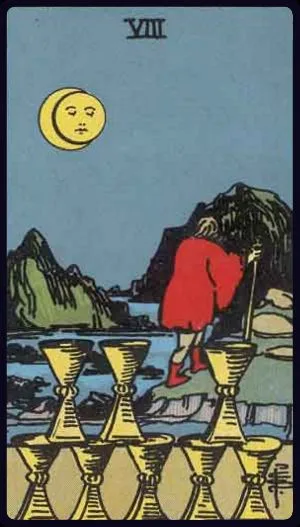
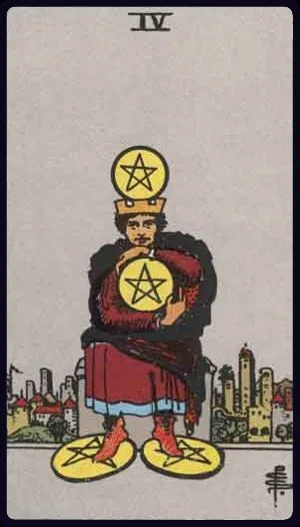
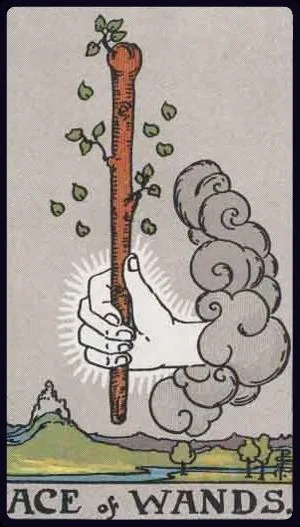
Reading it together. The story goes like this: the familiar work has stopped feeding you (Eight of Cups), but you are holding on to safety (Four of Pentacles), and the spread suggests not a leap but a trial (Ace of Wands). The practical takeaway: before deciding to leave, test one new possibility, such as a project, a course, or a conversation with people in a field that interests you. Notice that the spread didn’t say “quit” or “stay”: it named the reason for your doubts and offered a small step. That is what a good result looks like: you have a next move, not a “verdict.”
8 common misconceptions
- “The Death card means death.” No. Most often it marks the end of a chapter and a move to something new. A literal reading almost never applies.
- “Tarot predicts exact dates and events.” The cards describe trends and themes, not a schedule. They can’t answer “when exactly?”
- “You need a special gift.” You need attentiveness, knowledge of the symbols, and honesty with yourself. The “gift” is really just a habit of noticing details.
- “You can’t buy a deck for yourself or accept one as a gift.” That is a popular superstition, not a condition without which a reading “won’t work.”
- “A bad card means a bad forecast.” The Three of Swords or The Tower describe hard moments, but they often name exactly what is worth talking about out loud.
- “If you ask again, the cards get offended.” Cards don’t take offense. But repeating a reading on the same question usually produces mere variations of your anxiety; it is better to narrow or reword the question.
- “Tarot is a religion or magic.” Tarot is a set of symbols. It becomes a religious practice only for those who decide it is one.
- “The more cards, the more accurate the answer.” More cards bring more nuance, but also more noise. For a specific question, one to three cards are sometimes better.
Online reading or a live reader: what to expect
An online reading is fast, available at any moment, and free of social pressure: you don’t have to explain why you’re asking about work or relationships. A computer picks the cards at random, so there is no effect from the reader’s “mood.” In Oracul, cards are drawn from the full 78-card deck, and the interpretation is written from the cards drawn, their positions, and your question. This kind of reading is good for reflection, a quick answer to a specific question, and daily practice.
A live reader hears your tone, notices how you react to a card, and can ask a follow-up such as “what did you feel when you saw the Moon?” That is valuable when the situation is emotionally complex. The downsides are cost, time, and dependence on the reader’s skill; be wary of anyone who promises to “remove a curse,” scares and rushes you, or guarantees an outcome.
Either way, reasonable expectations are the same: you get material for reflection, not a ready-made decision. A good reading ends with your own conclusion and a step.
Ethics and limits: what tarot doesn’t answer
- Health. Cards don’t diagnose and don’t replace a doctor. If your health worries you, take the question to a doctor, not to a deck.
- Legal questions. “Will I win in court?” is a question for a lawyer. Tarot can help you understand how you feel about the situation, but not how the case will turn out.
- Money and investing. A spread won’t tell you what to buy or where to invest. Financial decisions rest on numbers and professional advice.
- Other people’s thoughts and private lives. Questions like “what is he thinking” or “is she cheating” stand in for a conversation with the person. Ask about yourself instead: “what do I feel and want in this relationship?”
- Crisis states. If you are in a hard place, turn to people close to you and to professionals, not to a spread.
A good practice is to write down the question, the cards, and your conclusion. A month later you will see what actually helped and what was self-suggestion, which is the best way to approach tarot without illusions.
What to read next
To keep going, choose a direction by what you need. If you want to learn the “alphabet” of the deck, start with the Major Arcana and the Minor Arcana. If you want practice, try how to word your question and the three-card spread. Individual card meanings are collected in the tarot card meanings section. You can draw a card for today in Card of the day, and for a complex question, use the Celtic Cross.
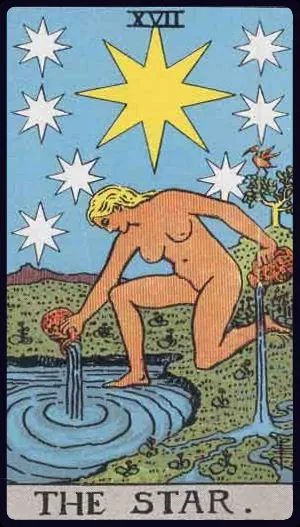
Oracul draws cards from the full Rider–Waite deck and explains your spread in plain language, right in Telegram.
Frequently asked questions
Is tarot fortune telling?
Not if you are being honest about it. A spread shows how you see a situation and which options are worth considering; it does not “know” the future. We suggest using tarot as a tool for reflection and planning, not as a verdict.
How many cards are in a tarot deck?
78: 22 Major Arcana and 56 Minor Arcana. The Minor Arcana are split into four suits (Wands, Cups, Swords, and Pentacles) of 14 cards each: ace through ten, plus four court cards.
What makes the Rider–Waite–Smith deck different?
Every one of its 78 cards carries a scene, including the Minor Arcana. That makes it easier for beginners: you can “read” a card from the picture, not only from a reference-book meaning. It is the main reason the Rider–Waite–Smith deck is the most widely used.
Do you have to believe in tarot for a reading to work?
You don’t need belief, but you do need honesty with yourself. A spread works like a mirror: if you are willing to look at your situation from a new angle, it will suggest one. If you are looking for approval of a decision you have already made, that is what you will see.
Can you read tarot for yourself?
Yes, though it is harder to stay objective. An open question, a written first impression, and the habit of asking “What would I tell a friend who drew this spread?” all help.
How is an online tarot reading different from a live reader?
An online reading is fast, always available, and free of anyone else’s mood: the cards are drawn at random and the interpretation is built from those cards and your question. A live reader hears nuance, asks follow-up questions, and offers support in a hard moment, which can matter more for major life decisions.