Why the three-card spread is the best place to start
Three cards is the minimum number that gives you a story: a beginning, a middle, and an end. One card gives an emphasis (“what to pay attention to”), two give a comparison, and three give a narrative. Yet it is still small: with three cards it’s easy to hold every connection in your head, and you don’t have to remember ten positions as in the Celtic Cross.
This kind of spread suits a specific question: “what is going on with my project,” “how should I act in this conflict,” “what matters about this relationship.” If you’re not yet familiar with the basics, start with “What Is Tarot? A Beginner’s Guide,” and use “How to Ask Tarot Questions” to plan your question.
Four three-card spread layouts
The cards themselves don’t “know” that they are the past or advice: the position gives them meaning. So choose a layout before you draw, and don’t change it afterward.
1. Past — Present — Future
When to use it. Use it when you want to see momentum: how the situation got to where it is and where it is heading. The third card is the likely direction if you stay on your current course, not a verdict.
2. Situation — Obstacle — Advice
When to use it. Use it for a concrete problem or decision. It is the most practical layout, and it ends with an action. The second card isn’t an “enemy”: it is what you underestimate or need to take into account.
3. You — Partner — Relationship
When to use it. Use it for questions about a couple, a friendship, or a business partnership. The “partner” card reflects your perception, not their actual thoughts, so read it as your view of them.
4. Mind — Body — Spirit
When to use it. Use it for questions about your state and balance: where you are right now in thought, action, and feeling. “Body” here means actions and habits, not health; a spread is not a medical diagnosis.
There is also a compact layout for decisions: “For — Against — What’s Missing.” It works well in place of a closed yes-or-no: two cards show the arguments, and the third shows what you’re not taking into account. For more on wording questions like this, see the article on how to ask a question.
Reading order and the role of the middle card
You can read left to right, but the order of thought is this: positions, pictures, links. First get clear on what each position answers. Then look at the cards one at a time without opening a reference book. Only after that, look for threads.
- 1Read the positions before the cards
Recall what question each position asks, for example “situation,” “obstacle,” “advice.” The card answers that question, not just “in general.”
- 2Describe each picture in one sentence
Who is on the card, what they are doing, what the mood is. Write down your first impression before you look up the reference meaning.
- 3Find the link between the first and second card
How does the second card respond to the first: does it reinforce it, argue with it, explain its cause, or create friction?
- 4See how the third card resolves the story
The third position is not the “outcome of your fate” but a direction: where the chain leads, or what helps you out of it.
- 5Sum it up in 2–3 sentences
If you can put it into one coherent thought, the spread is read. Finish with an action you can take this week.
The middle card is the “bridge”
The first card sets the starting state, and the third shows the direction. The second is what the shift happens through, which is why it gets special attention. Here is what it can do:
- Explain the cause: the first card is what is happening, the second is why.
- Create a conflict: in the situation, obstacle, advice layout, the middle card names what is in the way.
- Show the character of the transition: smoothly, through a choice, through a test, through a pause.
- Soften or amplify the first and third: the middle card colors both sides.
A useful trick: read the two “bridges” separately: “how does the first card lead to the second?” and “how does the second lead to the third?” If both transitions come together as clear sentences, the spread is clear.
A worked example: Wheel of Fortune, Three of Swords, Ace of Pentacles
The question: “What should I understand about the changes at work (my company is being reorganized) over the next three months?” The layout: situation, obstacle, advice. This is a teaching example: the cards were chosen to show the line of thought, not drawn at random.
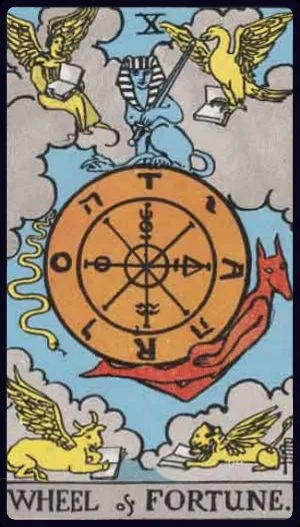
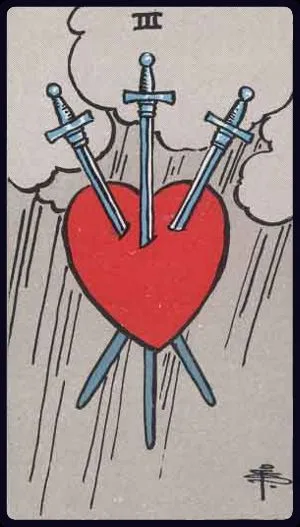
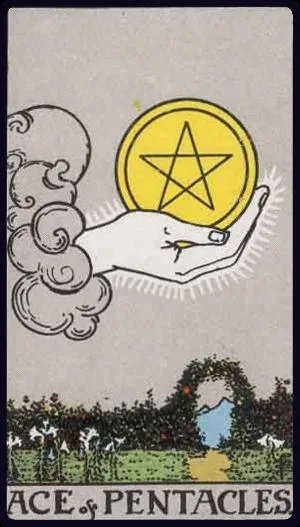
Step 1: the cards one by one
- Situation: Wheel of Fortune. A big wheel turning on its own. It stands for a cycle, change, and circumstances outside your control. What was “on top” goes down, and what was “below” rises. That fits a reorganization: the rules change regardless of you. (More on the card itself on the Wheel of Fortune page.)
- Obstacle: Three of Swords. A heart pierced by three blades, and rain. It is pain, loss, a hard word. In this position, what is in the way is not the change itself but how you are living through it: regret about what is ending, hurt, unspoken words.
- Advice: Ace of Pentacles. A hand from a cloud offers a coin above a blooming garden. It is a new practical opportunity: an offer, a resource, a prospect you can “touch.” As advice: notice it and take it.
Step 2: the links between the cards
From the first card to the second: the changes are in motion (Wheel), and they hurt (Three of Swords). This is not a bad forecast but an acknowledgment that it may be hard for you even if the changes are objectively neutral. The middle card is the “bridge”: it says you will first have to live through the loss, and only then take in the new. From the second to the third: the pain isn’t canceled, but behind it a concrete opportunity can be seen (Ace of Pentacles). The direction runs from experiencing the change to a practical step.
Step 3: the final reading
“The changes at work are moving forward regardless of you (Wheel of Fortune). The main difficulty lies less in the changes themselves than in how painful it is to part with what’s familiar (Three of Swords). Allow yourself to acknowledge that, and then look closely at the practical offers: a new role, a project, or new terms (Ace of Pentacles).” The practical takeaway: over the next three months, talk with your manager about expectations, not just process, and think through any concrete offer instead of turning it down out of habit.
What matters: the spread didn’t say “you’ll be laid off” or “you’ll be promoted.” It doesn’t answer questions about upcoming events and dates, but it names the inner obstacle and points to a direction for action, which gives you something to work with.
Reversed cards in a three-card spread
You can skip reversals entirely: then all three cards are read upright, and the spread is simpler and steadier. It is a good choice for beginners. If you do include reversed cards, keep three things in mind.
- Reversed doesn’t mean “bad.” Most often it is a shifted emphasis: the card’s energy shows up inwardly, slowed, or blocked.
- Position matters. A reversed Ace of Pentacles in the “advice” position is not “the opportunity is lost” but “the opportunity is there, though it’s hard to take for now” or “don’t rush.”
- Two or three reversed cards in a row are no cause for worry. With a random draw it happens, and it doesn’t “foretell” anything.
More in the article on reversed tarot cards. In Oracul, every card has an upright and a reversed position, and the interpretation takes that into account.
How to tell whether a spread is clear or muddled
Sometimes three cards come together at once, and sometimes they don’t. Here are the signs.
- A spread is clear if you can retell it in two or three sentences; a theme, suit, or image echoes between the cards; and the third card follows logically from the first two.
- A spread is muddled if the cards seem to “talk about different things” and you can’t find a common thread; you read each one from the reference book and there is no link; or you want to draw more cards to “clarify.”
What to do with a muddled spread: don’t keep drawing, go back to the question. Most often the cause is a vague question (“what will happen to me?”), a mix of two topics, or asking about someone else’s thoughts. Narrow the question, add a time frame, and do a new spread. Another trick is to start with the most striking image: the card your eye lingered on longest is the center of the spread.
How to word a question for three cards
Three cards answer best when the question starts with “what,” “how,” or “what can I learn,” has a time limit, and concerns your own actions. Compare: “Will I get a promotion?” (closed, about the outcome) and “What will help me prepare for a conversation about a promotion over the next month?” (open, about your steps). General rules, weak and strong examples, and 20 ready-made wordings are collected in “How to Ask Tarot Questions.” If you don’t want to choose a layout yourself, ask your question in a free spread.
What a three-card spread can’t do
- Dates and timing. Three cards won’t answer “when exactly.” They show a theme and a direction.
- Complex, multi-layered questions. When a situation has several sides (family, money, work), three positions may not be enough, and the Celtic Cross is a better choice; its positions are covered in the article “Celtic Cross: Positions.”
- Other people’s thoughts and feelings. The “partner” card shows your view, not their real thoughts.
- Verdicts. Diagnoses, court outcomes, and investment decisions are topics for a doctor, lawyer, or financial advisor; a spread doesn’t replace them.
- Guarantees. A spread shows likely tendencies and prompts for reflection, not a scheduled future.
Common mistakes
- Reading “by the dictionary.” You end up with three unconnected meanings; look for the story.
- Treating the third card as “the future that will surely happen.” It is a direction, if nothing changes.
- Changing the layout after the cards are drawn. That lets you bend the spread to what you want.
- Asking the same thing several times in a row. Every new spread adds confusion.
- Ignoring the middle card. It is often the one that holds the main hint.
To lock in what you’ve learned, draw three cards in the three-card spread section, or first look at the detailed guides to the Major and Minor Arcana. The meanings of individual cards are collected in the tarot card meanings section.
Oracul draws three cards from the full Rider–Waite deck and weaves them into a story about your situation.
Frequently asked questions
What is a three-card tarot spread?
It is a tarot layout in which you draw three cards and read them by position, such as “past, present, future” or “situation, obstacle, advice.” Because there are so few cards, it suits beginners and experienced readers alike.
Which three-card spread is best?
There is no single best layout; it depends on the question. Past, present, future suits “what is going on,” situation, obstacle, advice suits a decision, and you, partner, connection suits relationships.
How do I know if a spread is clear or muddled?
A clear spread comes together as one coherent story: the cards echo each other in theme or suit, and the third position follows logically from the first two. If the cards argue with each other, a vague question is often to blame, not a “bad” spread.
Should I use reversed cards?
You don’t have to. Beginners find it easier to read every card as upright. If you do use reversals, read them as a shifted emphasis or an inward expression of the card, not as a “bad meaning.”
How do I read the middle card?
The middle card is the “bridge” between the beginning and the end. It explains what the situation passes through on its way to the next stage: an obstacle, a choice, an emotion, or a decision.
Can I do a three-card spread every day?
Yes, as long as each time there is a new question or a new situation. For a daily practice, most people draw a single card of the day and save three cards for specific questions, so they don’t drown in interpretations.