General meaning
The Eight of Swords describes the state where it seems there’s no way out: obligations, fears and “you can’t” on every side. But the card’s key feature is that the limits are largely built out of thoughts. You believe one step to the left will lead to disaster, that no one will support you, that it’s already too late. Those beliefs are stronger than any bars.
The card doesn’t deny real difficulties, and it doesn’t say “just pull yourself together.” It points out that what stands between you and freedom is less an outside wall than an inner stance. Often it’s enough to re-check one of the “undeniable” facts to discover that a path exists.
The Eight appears when it’s time to change your lens: instead of asking “why can’t I,” ask “what exactly is in my way, and what can realistically be changed today?” This isn’t easy optimism; it’s about small, testable steps.
What’s pictured on Eight of Swords
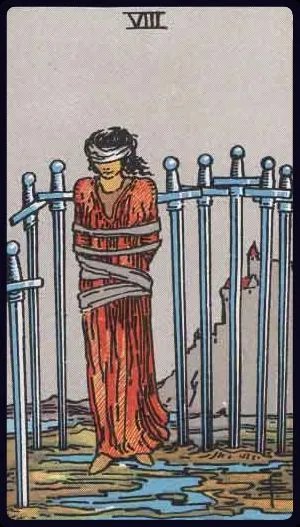
In the center stands a blindfolded woman. Her body is wrapped in strips of cloth, but the knots look loose and her feet are free: she could move quite easily. Eight swords are planted around her, forming an incomplete ring. There’s a gap between them.
Water lies underfoot—a puddle or an overflowing stream. In the distance, a castle stands on a cliff, a symbol of home, safety and authority. The sky is grey and cold, the dress red, like the passion or life force that is being held back. The image suggests that the limits seem powerful, but in fact she can turn, step back and walk away.
Eight of Swords in love and relationships
In relationships, the card speaks of a sense of being caught in a trap: it seems you can’t leave, there’s no one to explain to, and nothing can be changed. The reasons vary: fear of being alone, financial dependence, a habit of putting up with things. Sometimes it’s about how you restrict yourself from showing your feelings.
For singles, the card shows a fear of meeting new people: “it won’t work out for me,” “nobody will choose me.” Such thoughts aren’t facts but a habit, and one that can be changed gradually.
The blindfold loosens: you start to see exits, speak aloud about what’s happening, and look for support. That may be a decision to leave or, on the contrary, to rebuild the relationship on new terms. What matters is that you’re no longer a hostage to the situation.
What your partner feels
The person you’re asking about may feel locked in: by obligations, by the past, by their own fears. They’re not necessarily indifferent, but they don’t know how to move, and so they stay put or “freeze.”
Don’t push or demand certainty: the harder the pressure, the tighter the defensive reaction. It’s better to show that it’s safe beside you and suggest one specific small step. If it’s taken, the picture will change.
Career and money
It seems you’re stuck: the job doesn’t suit you but there are “no” alternatives; debts or obligations keep you in place. It helps to list point by point what exactly ties you down and which of those points are real. Sometimes there’s someone nearby who can point out a way out. With money, it’s a feeling of having no options when funds are short. Draw up a budget, talk to a creditor early, and consult a professional.
You see options and try something new: a résumé, negotiations, study, a talk with your boss. The card shows that the “walls” were lower than they seemed. But the opposite is possible too: you still underestimate your options and brush off help.
Health and well-being
In questions of well-being, the card speaks of tightness and tension: anxious thoughts that make it hard to relax and fall asleep, a habit of “putting up with it” and ignoring your body’s signals. Breathing exercises, gentle stretching and a talk with someone you trust can help.
If your thoughts won’t let go and everything feels hopeless, please don’t stay alone with it. See a therapist or a doctor: that is a normal and sensible step. This is not medical advice.
Tarot is a tool for reflection, not a diagnosis or medical, financial, or legal advice. If you have health concerns, please see a doctor.
Yes or no?
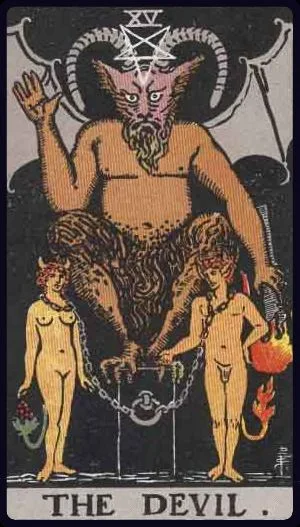
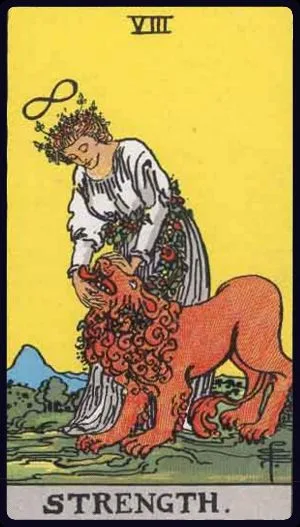
An example Situation · Obstacle · Advice spread: The Devil shows dependence and attachment, the Eight of Swords the belief that there’s no way out, and Strength advises moving forward gently and with confidence.
Eight of Swords as advice and card of the day
Take a sheet of paper and list all the “can’t” and “impossible” items connected with the situation. Next to each, put a question: is this a fact or an assumption? What happens if I test it? Usually only two or three of ten turn out to be real.
Then pick one small action: make a call, ask a question, send an application. Not “change my life,” just one test step.
Eight of Swords as your card of the day
A day when you’ll probably run into a sense of limits: not enough time, freedom or opportunity. Notice which thoughts sit behind it. Try not to accept them as final, and find at least one loophole. In the evening, write down what turned out to be easier than it looked in the morning.
Combinations with other cards
- Attachment and fears that hold tighter than any chains.
- + StrengthInner strength that helps you remove the blindfold and move on.
-
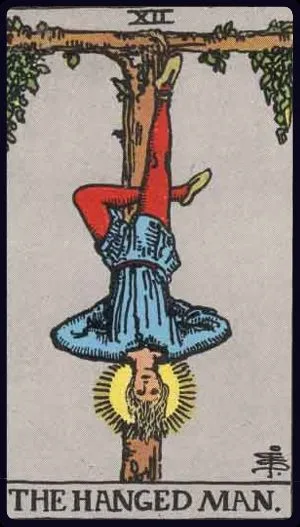 A forced stop that brings a new perspective.
 -
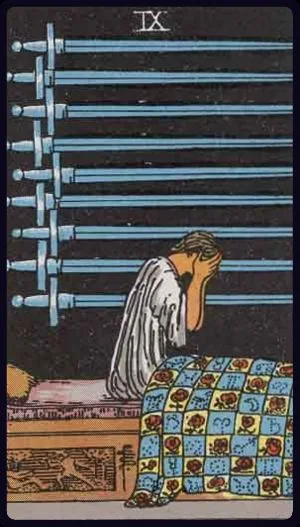 Anxiety and self-blame layered on top of each other.
 -
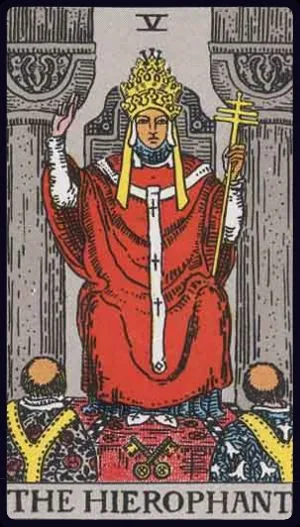 Society’s rules and expectations in which you feel boxed in.
Eight of Swords reversed
Reversed, the card tells you the blindfold is slipping and you can see more than before. The first step may be very small: admit that you’re struggling, or call for help. Release, decision and change follow.
There’s another shade, though: you’ve already left the trap, but the habit of fear remains. You sit “at liberty” with your eyes still covered. Then the card suggests practicing small decisions and gradually rebuilding trust in your own choices.
Questions about this card
What does the Eight of Swords mean in a relationship?
A sense of being trapped: it seems you can’t leave or change anything. Often the limits exist in your thoughts, where they can be tested and reconsidered.
What does a man feel when the Eight of Swords comes up?
He feels bound by circumstances or fears and doesn’t know how to move. It isn’t always indifference; more often it’s confusion.
Is the Eight of Swords a yes or a no?
It leans toward “no” or “not yet.” But the card suggests that a way out will appear once your view of things changes.
What does the Eight of Swords reversed mean?
Release: you see the way out and take the first steps. Sometimes it’s a habit of fear that lingers after the danger has passed.
How do I get out of an Eight of Swords situation?
Sort your “can’ts” into facts and assumptions, and choose one small step. If it’s hard to manage alone, talk to someone close or a specialist.