General meaning
The Nine of Swords is familiar to anyone who has ever woken at three in the morning with a heart pounding from thoughts. The card shows anxiety, guilt, the “what ifs” and the “why did I say that” that go round in circles and look worse in the dark. It doesn’t claim that trouble is inevitable; it shows how the thoughts around an event can weigh more than the event itself.
What this card offers that is useful is separation. There are real problems that can be solved by taking action, and there are imagined scenarios that exist only in your head. By day, in the light and in conversation with another person, the second kind usually shrinks several times over.
That’s why the Nine is not a diagnosis or a verdict but a signal: you’re overloaded and need support. Not “pull yourself together” but “talk,” “rest,” “ask for help.” Often it’s enough to say aloud what’s gnawing at you for the tension to begin to ease.
What’s pictured on Nine of Swords
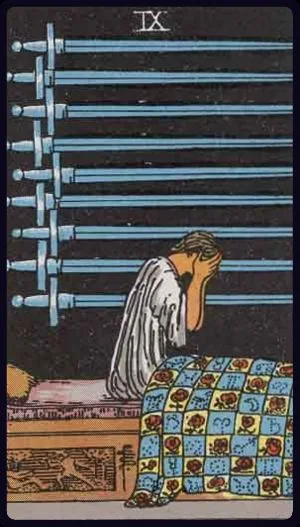
A person sits up in bed with their face in their hands: either just woken or never asleep. Behind them, on a black background, nine swords hang horizontally like a grille, but none of them touches the figure. It is night, dark, with no source of light.
The bedspread is embroidered with red roses and zodiac signs—symbols of life, feeling and time. The carving on the bed frame shows a scene of struggle, one figure bent over another: a hint at guilt or something lived through. The swords aren’t plunged into the person; they “hang” nearby—like thoughts that press down but so far remain only thoughts. The picture shows suffering, but it also hints that once you switch on a light, the picture changes.
Nine of Swords in love and relationships
In relationships, the card speaks of anxiety: “does he love me?”, “did I say too much?”, “what if I’m left?” The thoughts spin scenarios that reality hasn’t confirmed. There may also be guilt toward a partner or an ex.
If you’ve been through a painful breakup, the Nine describes what comes afterward: memories at night, attempts to understand “what went wrong.” That’s a normal part of the experience. A talk with a friend, a journal and a daily routine help more than endless replaying.
Anxiety eases: you find a way to talk, and it gets lighter. You may decide to share your fears with someone close. But the card can also show suppression, when you pretend all is well and the tension stays inside.
What your partner feels
The person is worried, anxious and possibly feeling guilty. They may replay your conversations, fret about the relationship, or not know how to express what’s on their heart. Anxiety and attachment often go side by side here.
That doesn’t mean there are no feelings—on the contrary, they’re thinking about you. But in this state they can behave inconsistently: going quiet or snapping. Gentle, calm contact will help more than pressure.
Career and money
Work worries: fear of a mistake, stress over a project, layoffs, a manager’s evaluation. The thoughts won’t let you switch off even at home. It helps to write down exactly what is bothering you and sort tasks into “I can solve this” and “not in my control.” With money, it’s anxiety over expenses and debts: draw up a realistic picture, which is usually less frightening than the imagined one.
The tension drops: you finally got an answer, reached an agreement, or simply slept and saw the situation more clearly. But sometimes you hide your worries from colleagues and take on too much. Admitting you’re struggling isn’t weakness; it’s a way to get your energy back.
Health and well-being
The Nine of Swords is closely tied to night-time anxiety and poor sleep. If you recognize yourself, try simple things: a routine, an evening ritual without screens, writing your thoughts on paper, breathing exercises, a talk with someone close.
Important: this is not medical advice. If anxiety, insomnia or low mood last more than two or three weeks or get in the way of daily life, please see a doctor or a therapist. That is an ordinary, sensible step, not a sign of weakness. The card here is not a diagnosis but a reminder to take care of yourself.
Tarot is a tool for reflection, not a diagnosis or medical, financial, or legal advice. If you have health concerns, please see a doctor.
Yes or no?
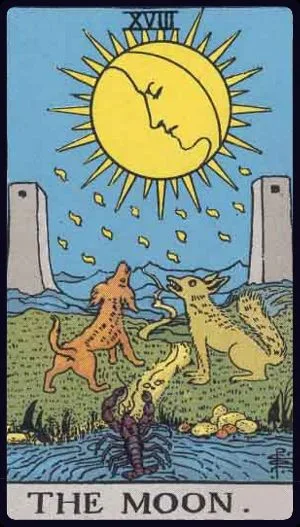
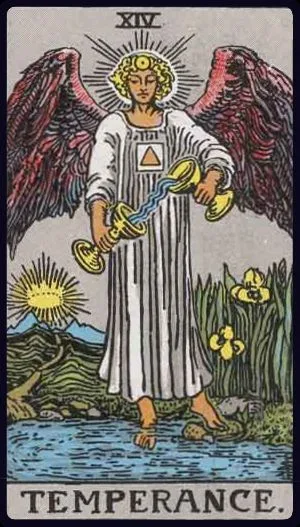
An example What worries you · What’s really going on · What will help spread: the Nine of Swords shows night-time fears, The Moon that much of it is assumed, and Temperance advises evening out your routine and breathing.
Nine of Swords as advice and card of the day
Don’t stay alone with your fears. Tell someone what’s troubling you, or write it all in columns: what happened, what I’m afraid of, what can realistically be done. The list of “real actions” usually turns out shorter and clearer.
Take special care of the night: an earlier dinner, a warm shower, your phone away from the bed. Anxious thoughts look for a reason at night, so it’s best to give them neither food nor a screen.
Nine of Swords as your card of the day
It may be a day with an anxious undertone: thoughts spin, though there’s hardly a reason. Don’t try to beat them by force. Plan one pleasant, simple thing: a walk, a cup of tea, a call to someone close. If something truly worries you, identify one step you can take today. In the evening, go to bed a little earlier.
Combinations with other cards
- + The MoonAnxiety and imagination inflate what isn’t there in reality.
-
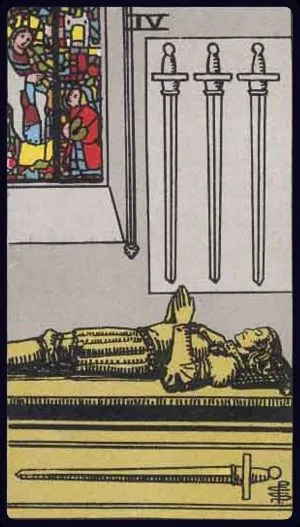 Anxious thoughts need real rest.
 -
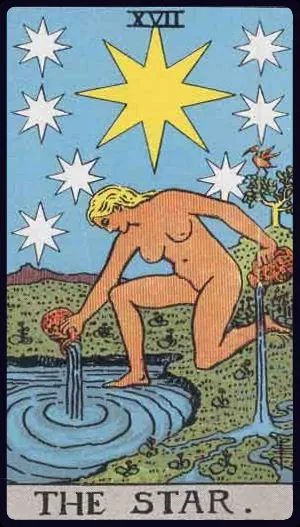 + The StarAfter an anxious period come hope and support.
 -
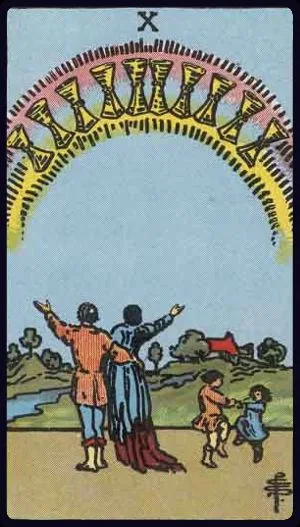 The warmth of family and loved ones helps you cope with worries.
 -
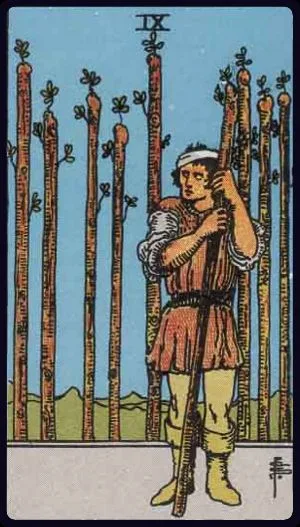 You’re tired of holding the defense and fear another blow.
 -
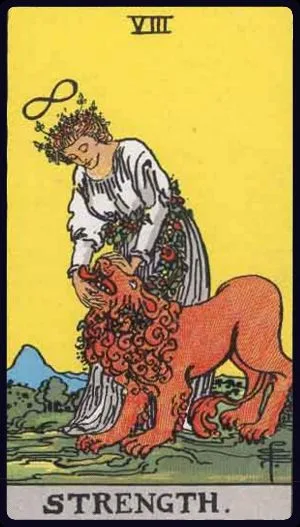 + StrengthA gentle inner strength helps you live through the fear instead of fighting it.
Nine of Swords reversed
Reversed, anxiety either recedes or goes deeper. Good signs: you’ve slept, talked, and seen that the fears were bigger than reality. You ask for help and get it.
The second version is suppressed anxiety, when a person won’t admit they’re struggling. It shows up as irritability, tiredness, detachment. The card gently reminds you that what goes unspoken doesn’t disappear. Find a safe place to talk about it, whether a friend, a journal or a professional.
Questions about this card
What does the Nine of Swords mean in a relationship?
Anxiety, doubts at night and guilt. Often the real situation is better than the imagination paints it, which is why an open conversation helps.
What does a man feel when the Nine of Swords comes up?
He’s worried, anxious and perhaps feeling guilty. It may be hard for him to put it into words, so he behaves inconsistently.
Is the Nine of Swords a yes or a no?
It leans toward “no,” or “don’t decide with an anxious mind.” Wait for a calm moment and come back to the question.
What does the Nine of Swords reversed mean?
Either relief and fading fears, or suppressed anxiety. If it gets in the way of daily life, it’s worth seeing a professional.
How do I cope with a Nine of Swords state?
Talk to someone close, write your thoughts down, and set up a steady sleep routine. If insomnia and anxiety last longer than a few weeks, see a doctor or a therapist.